About me
“I have died many times in this lifetime.”
This is the first sentence in my upcoming memoir. My life has embodied the ineffable, wildly chaotic compulsivity of an addict diametrically juxtaposed (often simultaneously) with highly ordered academic, entrepreneurial, athletic, and musical pursuits. Now, as a father to a 10-year-old daughter who lit up my life and led to my sobriety shortly after her birth, I do my best to clearly and concisely articulate how the various forms of reality interact. Similarly, my memoir is my absolute best attempt to diagnose and describe experiences that most people will never share. For example:
I started drinking at age 12 and doing hard drugs at age 14. By the time I was done with high school, I had a 7-gram per day cocaine habit, took 30-40 pills of ecstasy per week, had tried 47 drugs, had been arrested three times, and spent the last six months of senior year in Second Nature Wilderness Therapy. I also made it to state for tennis and was accepted into the prestigious Claremont Colleges. At Pitzer, I managed all live events on campus, became President of the Music Coalition, played in 2-4 bands simultaneously for all four years (sometimes playing live with them all on the same night while I managed the event staff), worked at an all student-run restaurant, and earned a B.A. in Psychology in four years with a 3.3 GPA. Yet by senior year, I was also drinking a half gallon of whiskey, taking 2-8 hard drugs, and smoking an 1/8 oz of weed and 1-2 packs of cigarettes every single day.

I’m a bit crazy
Or I was, as that 50,000-foot view of my story indicates. Just look at 2012 hippie Jake's shit-eating grin as he holds a carton of Lucky Strike cigarettes with a huge "Smoking kills" warning label. Many of my friends from that era are still addicts, homeless, or imprisoned. Or dead. Which begs the questions: Why am I not still an addict? Why was I born to a mother who nursed me back to health rather than let me become homeless? I didn't deserve her love. I've been arrested six times, and I deserved every arrest. But I was never caught for my truly terrible crimes, so why am I not imprisoned? How on earth am I not dead?
The only honest answer I have is grace — a gift I didn't earn and couldn't have manufactured on my own. My journey to sobriety integrated faith, intensive personal work, and the transformative power of music. I don't claim to fully understand why I was given a second chance when so many others weren't, but I've come to see it as a calling to steward this opportunity well.
When I zoom in past 50,000 feet, I typically watch people recoil in horror. My experiences from that time are simply the type of stories that make people cringe as they read about them in the news, only to wipe their memory of that story clean and go about their lives.
But I cannot wipe my memories. They are lived experiences. I have stretched my range of experience and perception further than most human beings I know. Reflecting on my lived experiences with people from all walks of life, one fundamental truth has become crystal clear. Even those who suffer believe the actions they take will lead to beauty. They're just misguided, chasing momentary beauty rather than laying the foundation for sustainable beauty. Which is why I became an educator — not just to share information, but to serve others by helping them discover truth through their own experience.

What I rebuilt — and how
Music practice was the discipline that rebuilt what addiction had damaged. Not therapy alone. Not faith alone. Not willpower alone. The specific, daily, structured practice of making music rewired neural pathways that drugs had degraded. I had studied neuroscience as part of my psychology degree at Pitzer — years before I got sober. The academic knowledge alone didn't save me. But when music practice began to rebuild what addiction had damaged, the neuroscience I'd already learned helped me understand why it was working — and that understanding reshaped my entire professional life.
Neuroscience has identified performing music as one of the most cognitively demanding activities the human brain can undertake. It simultaneously engages executive function, motor planning, emotional processing, language centers, and multimodal sensory integration in ways no other single activity can replicate. The principles I used to rebuild my brain through music weren't music principles. They were human performance principles — cognitive load management, spaced practice, attentional control, and mind-body integration — that happened to be most rigorously testable in the demanding context of musical practice.
In every serious field, we trust primary sources over secondhand accounts. Members of our judicial system want testimony from the defendant or eyewitness — not hearsay. Medical practitioners prefer to see the patient, not their parent or guardian. Researchers want primary sources, not secondary ones. There's a reason attorneys practice law, doctors practice medicine, and therapists run a clinical practice. The word means something. Disciplined, repeated engagement with the real thing produces a kind of knowledge that no amount of reading about it can replicate. I practice music — and it was that practice, not theory about music, that rebuilt what addiction had destroyed.

That insight became the foundation for everything I've built since. I designed a curriculum for 20 instruments. I personally beta-tested it in five schools every week for an entire year. I taught in a homeschool co-op. I designed the private lesson and mentorship models based on recent research. I lectured Ph.D. candidates and Master’s students across the United States. I watched that methodology scale to 2,821 educators across 831 school districts in 90+ countries — with 150+ music educators volunteering their own time to build within the framework. Not because I asked them to. Because the methodology was sound enough for professionals to trust it with their own expertise.
I hold a B.A. in Psychology from Pitzer College, completed the Executive Development Program at the University of Washington Foster School of Business, earned a Financial Accounting Certificate from Harvard Business School Online, and hold a 200-hour Yoga Teaching Certification. I reversed almost all mental, emotional, and physical damage from fourteen years of severe addiction through deliberate, systematic work on sleep, nutrition, movement, and recovery — something most addicts, and most human beings in general, cannot say. For a complete record of my work experience, presentations, in-services, curriculum design, and technology development, view my full Curriculum Vitae.
My approach to education is rooted in servant leadership — meeting people where they are, honoring their inherent dignity and worth, and walking alongside them as they discover their own path to wholeness.
What I do now
Practicing Musician — I'm the Founder, Chairman, and CEO of one of the world's most widely adopted music education platforms, reaching 2,821 educators across 831 school districts in 90+ countries. I designed the curriculum, composed the sheet music, produced the video tutorials, and built the methodology. The platform's content has a 66% video completion rate — nearly double the industry average. The Fundamentals of Music Mastery courses are free for everyone, forever — and for those who want guided instruction, Practicing Musician offers private lessons with expert teachers trained in my methodology at $90/month for four sessions. Through Practicing Musician, we’re working to found Worshiping Musician, a worship music education organization serving churches and Christian homeschoolers.
ClimbHigh.AI — I'm the Founder, Chairman, and CEO of an AI-powered educational technology platform applying the same principles that made Practicing Musician successful to every field of education.
Classical Transcription Project — I serve as a Founding Board Member, guiding technological integration and fostering relationships in the classical music community.
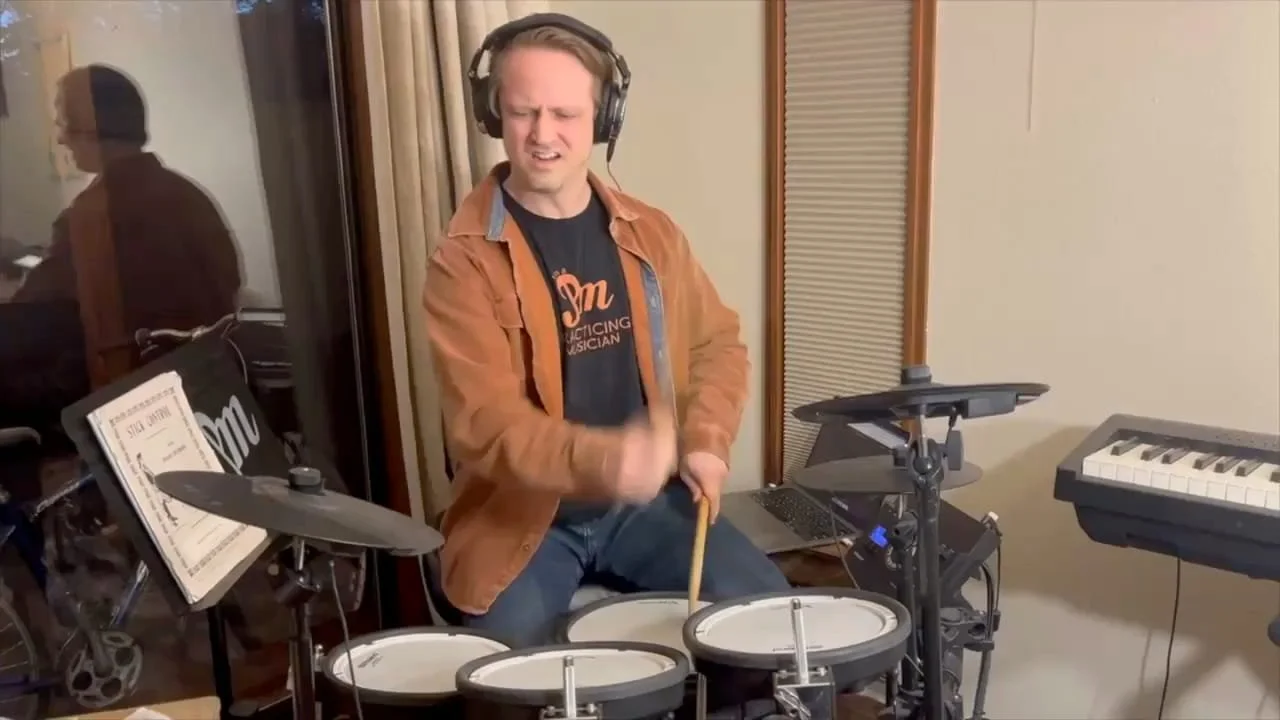
The Fig Atones — I'm the drummer for The Fig Atones, where I bring 30+ years of performance experience to the stage and keep the musical practice that rebuilt my life alive and active.
Jake's Private Studio — I accept 10 private students at any given time. My coaching spans advanced drumset technique, applied neuroscience, performance anxiety, mindfulness, health optimization, music and recovery, spiritual formation, curriculum design, and entrepreneurship. Several of these topics serve non-musicians. Read why the neuroscience behind these sessions applies to any discipline.

The core of what I teach
Music as the most demanding cognitive-motor activity neuroscience has identified — and why principles mastered here transfer to every discipline.
Performance under pressure — the neuroscience of why high performers choke, and how to manage it, whether you're on a stage, in a courtroom, or in a boardroom.
Recovery — I've suffered almost every addiction in the books, most more severe than 95% of addicts. I achieved sobriety — something only 15-20% of addicts can claim — through methods I personally designed that integrated faith, neuroscience, and the mind-body-spirit connection developed through music practice.
Faith and stewardship — we spend time and pay attention. These aren't metaphors. They're our two primary currencies. I teach people to invest both currencies in sustainable unity, truth, beauty, and goodness. While I approach these topics from a Christian perspective, I respect that each person's journey is unique and meet them where they are.
Health optimization — I reversed almost all mental, emotional, and physical damage from fourteen years of severe drug and alcohol abuse. This work required treating the whole person — mind, body, and spirit — with intentionality and grace. I bring that same systematic approach to the musicians, professionals, and transformation seekers in my studio.

Ready to begin?
I work with these ideas one-on-one through my Private Studio — limited to 10 students at any given time. Whether you're a musician seeking a breakthrough, a professional exploring the neuroscience of peak performance, or someone in recovery looking for a disciplined practice that transforms, the Discovery Session is where we start.
I also explore the neuroscience behind this work in depth: If It Works in Music, It Works Everywhere.